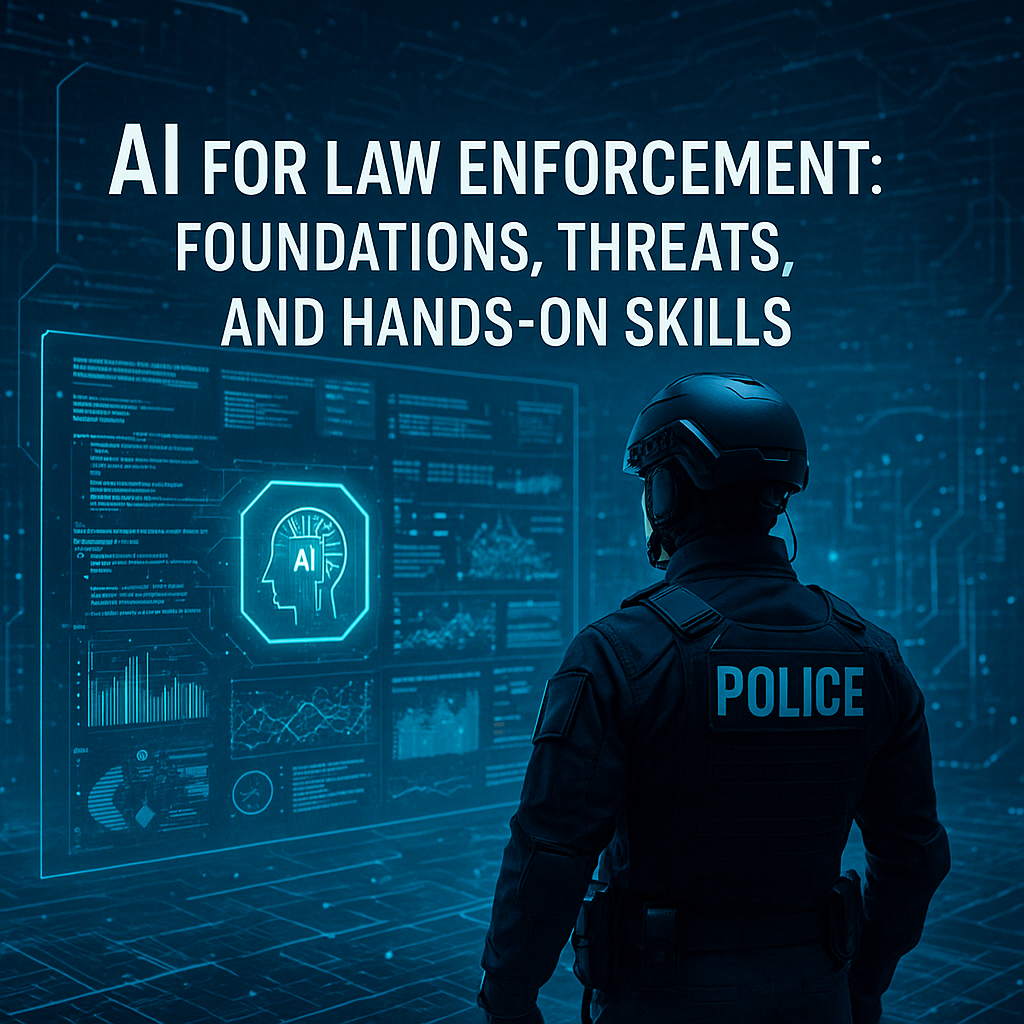
AI for Law Enforcement: Foundations, Threats, and Hands-On Skills (2 Days)
Course Overview
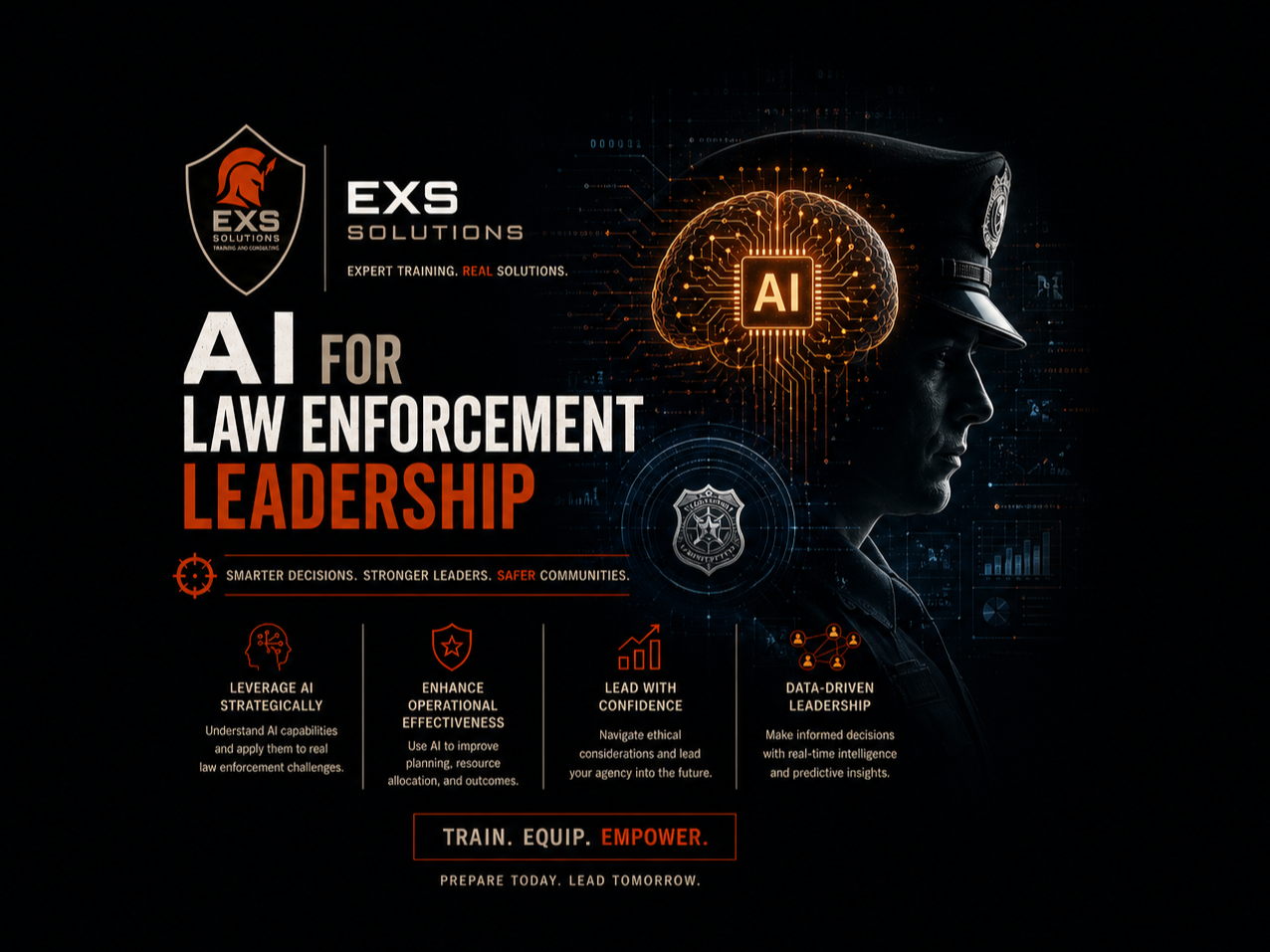
A two-day, solution oriented introduction to AI for Law Enforcement. Day 1 builds a foundation, understanding, application, AI threats, AI detection, evidence triage and State and Federal Laws governing AI . Day 2 turns concepts into repeatable workflows using free, accessible tools. You’ll learn where AI adds value, where it can fail, how to operate within policy, guidelines, CJIS, and constitutional boundaries. You will leave this course knowing how you use AI in your everyday work and life safely and effectively.
What You’ll Learn (Learning Outcomes)
By the end of the course, participants will be able to:
Explain core AI capabilities and limitations in plain terms, and identify appropriate law-enforcement use cases.
Recognize AI-enabled threats (deepfakes, voice cloning, black-market LLMs, dark-web services) and apply a basic triage workflow to digital media.
Use AI productively for writing, translation, scheduling, and personal stress reduction—without exposing CJI/PII to public tools.
Describe the “perceive–think–act” loop of AI agents and apply verification steps before relying on AI output.
Plan and simulate an undercover social-media persona, using AI to safely build content, maintain OPSEC, and avoid detection.
Craft effective prompts using the Who / What / Why + How / Constraints / Format model and iterate for accuracy and clarity.
Execute six hands-on workflows you can repeat on duty with appropriate approvals and CJIS-compliant platforms when required.
Who Should Attend
All Law Enforcement, task-force analysts, and law-enforcement leaders seeking entry-level yet practical AI skills for investigations, intelligence, and administrative efficiency.
Key Takeaways & Deliverables
Prompt Library (copy-ready) using Who/What/Why + How/Constraints/Format.
Report-drafting workflow for training and other training tools.
Undercover persona development (sandbox): persona , story, posting tips and tricks, OPSEC & engagement techniques.
Deepfake triage and evidence intake worksheet (inspection findings + tool result + decision).
Capstone outline for AI projects and project management.
Tools & Access (All Free)
ChatGPT. Gemini, Copilot, Grok, Perplexity, Claude (free tier) for text generation/translation/summarization (training data only).
AI headshots: ThisPersonDoesNotExist.com (non-real faces).
Reverse-image search: Google Images / TinEye.
Deepfake checks: publicly accessible detectors or portals demonstrated in class.
Alternatives provided for restricted networks.
Prerequisites & Technical Requirements
None (entry level), everyone can learn how to implement AI into the workflow and where it will benefit you.
Each learner needs a laptop with internet access (Internet provided on-site).
Modern browser (Chrome/Edge/Firefox); ability to create free online accounts.
FAQs
Is this course technical?
No. It’s designed for first-time AI users in law enforcement and leaders setting policy.
Will we build real undercover profiles?
No. You’ll plan and simulate only. Real operations will not be conducted.
Can I use these tools after class?
Yes. All demonstrated tools have free, accessible options for continued practice.
*For Law Enforcement*
AI for Law Enforcement: Foundations, Threats, and Hands-On Skills (2 Days)
Course Overview
A two-day, solution oriented introduction to AI for Law Enforcement. Day 1 builds a foundation, understanding, application, AI threats, AI detection, evidence triage and State and Federal Laws governing AI . Day 2 turns concepts into repeatable workflows using free, accessible tools. You’ll learn where AI adds value, where it can fail, how to operate within policy, guidelines, CJIS, and constitutional boundaries. You will leave this course knowing how you use AI in your everyday work and life safely and effectively.
What You’ll Learn (Learning Outcomes)
By the end of the course, participants will be able to:
Explain core AI capabilities and limitations in plain terms, and identify appropriate law-enforcement use cases.
Recognize AI-enabled threats (deepfakes, voice cloning, black-market LLMs, dark-web services) and apply a basic triage workflow to digital media.
Use AI productively for writing, translation, scheduling, and personal stress reduction—without exposing CJI/PII to public tools.
Describe the “perceive–think–act” loop of AI agents and apply verification steps before relying on AI output.
Plan and simulate an undercover social-media persona, using AI to safely build content, maintain OPSEC, and avoid detection.
Craft effective prompts using the Who / What / Why + How / Constraints / Format model and iterate for accuracy and clarity.
Execute six hands-on workflows you can repeat on duty with appropriate approvals and CJIS-compliant platforms when required.
Who Should Attend
All Law Enforcement, task-force analysts, and law-enforcement leaders seeking entry-level yet practical AI skills for investigations, intelligence, and administrative efficiency.
Key Takeaways & Deliverables
Prompt Library (copy-ready) using Who/What/Why + How/Constraints/Format.
Report-drafting workflow for training and other training tools.
Undercover persona development (sandbox): persona , story, posting tips and tricks, OPSEC & engagement techniques.
Deepfake triage and evidence intake worksheet (inspection findings + tool result + decision).
Capstone outline for AI projects and project management.
Tools & Access (All Free)
ChatGPT. Gemini, Copilot, Grok, Perplexity, Claude (free tier) for text generation/translation/summarization (training data only).
AI headshots: ThisPersonDoesNotExist.com (non-real faces).
Reverse-image search: Google Images / TinEye.
Deepfake checks: publicly accessible detectors or portals demonstrated in class.
Alternatives provided for restricted networks.
Prerequisites & Technical Requirements
None (entry level), everyone can learn how to implement AI into the workflow and where it will benefit you.
Each learner needs a laptop with internet access (Internet provided on-site).
Modern browser (Chrome/Edge/Firefox); ability to create free online accounts.
FAQs
Is this course technical?
No. It’s designed for first-time AI users in law enforcement and leaders setting policy.
Will we build real undercover profiles?
No. You’ll plan and simulate only. Real operations will not be conducted.
Can I use these tools after class?
Yes. All demonstrated tools have free, accessible options for continued practice.
*For Law Enforcement*